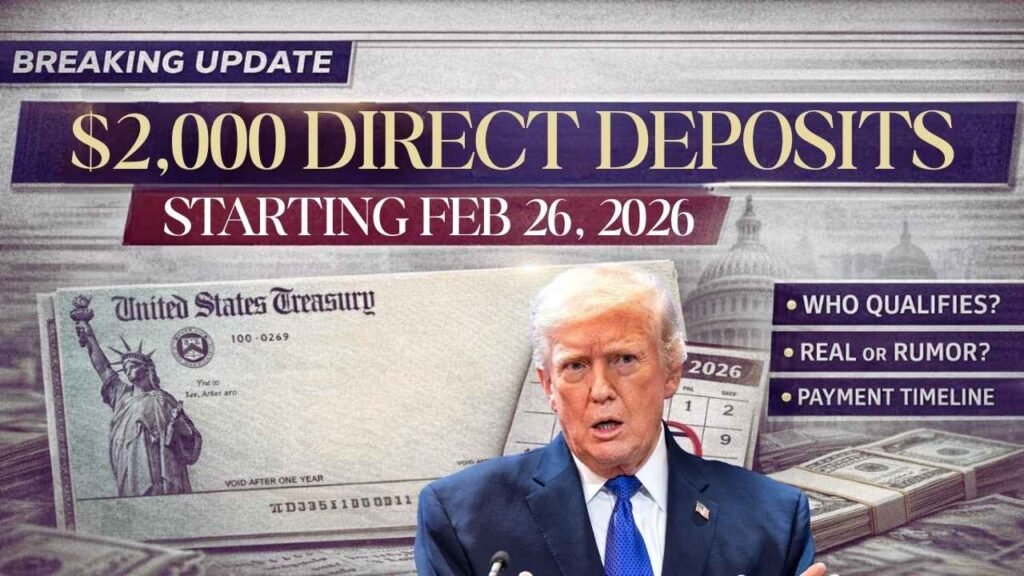
Claims that a new $2,000 federal direct deposit is beginning on or around February 26, 2026, have circulated widely on social media and some online articles. These often describe it as a stimulus payment, relief check, tariff dividend, or special IRS deposit hitting accounts starting late February. However, as of late February 2026, no such universal $2,000 federal payment program has been officially confirmed, authorized, or launched by the IRS, Congress, or the White House.
Reliable sources including IRS announcements, major news outlets, and fact-check reports indicate that no new nationwide $2,000 direct deposit is scheduled for February 26 or any specific date in February 2026. Here’s the current reality, why the rumors persist, and what people might actually be receiving.
No Authorized $2,000 Federal Payment Program
The IRS and federal government have not announced or begun any broad $2,000 direct deposit initiative in February 2026. Official IRS news focuses on the ongoing 2026 tax filing season (for 2025 returns), standard refunds, and routine updates—no mention of a new stimulus, tariff rebate, or one-time relief payment of $2,000.
President Trump’s repeated proposal for a $2,000 “tariff dividend” (using tariff revenue to send checks to middle- and lower-income households, excluding high earners) remains unapproved. In interviews and statements from late 2025 into early 2026, Trump suggested payments could happen “toward the end of the year” or sometime in 2026, but no formal legislation, funding allocation, or IRS implementation exists. Recent Supreme Court rulings striking down certain tariff authorities have further complicated any potential funding source, making large-scale payouts even less likely in the near term.
Viral claims about payments starting February 26 (or waves from February 6–28) lack official backing and often stem from misinformation, speculation, or confusion with regular tax processes.
What Deposits Around $2,000 in February Likely Are
If you’re seeing or expecting a federal deposit near $2,000 around late February 2026, it’s almost certainly tied to standard tax season activity:
- Tax refunds — Early filers (especially those claiming refundable credits like the Earned Income Tax Credit or Child Tax Credit) frequently receive refunds in the $1,500–$3,000 range via direct deposit. The IRS began processing 2025 returns in late January 2026, and refunds typically arrive within 21 days for e-filed returns with direct deposit.
- Refundable credits and adjustments — Overpayments, prior-year corrections, or combined credits can result in deposits around $2,000.
- Federal benefit timing — Social Security, SSI, or other payments may align with tax processing, sometimes totaling near $2,000 when combined.
These appear as “IRS TREAS 310” or similar on bank statements and are normal—not a new program.
Who Might “Qualify” for Routine IRS Deposits
For standard refunds or credits (the most likely source of any $2,000-ish deposit):
- You filed a 2025 federal tax return (or had one processed) with direct deposit information.
- You qualify for refundable credits (e.g., EITC for lower-to-moderate incomes, often up to $60,000–$70,000 single or higher with dependents; Child Tax Credit portions).
- You overpaid taxes or have adjustments/credits applied.
No separate application is needed—these are automatic based on your return.
For the proposed tariff dividend (if/when it ever materializes):
- Likely targeted at middle- and lower-income households (e.g., excluding high earners, per Trump’s comments).
- U.S. taxpayers/residents who file returns.
- No confirmed eligibility details exist yet.
How to Verify Any Deposit
- Check official IRS tools: Use “Where’s My Refund?” at IRS.gov with your SSN, filing status, and expected amount. It shows if/when a refund was issued.
- Bank details: Look for “IRS TREAS” or “TAX REF” descriptors—trace it to your tax return.
- Avoid scams: The IRS never demands payment, fees, or info via unsolicited messages to “claim” funds. Ignore third-party “verification” sites or urgent alerts.
If a deposit doesn’t match any expected refund, contact your bank and the IRS directly (use official contact info from IRS.gov).
Conclusion
There is no confirmed $2,000 federal direct deposit beginning February 26, 2026. Rumors likely confuse routine tax refunds during the busy early filing period with unapproved proposals like the tariff dividend. Any real new payment would require congressional action and IRS announcements—none have occurred. For accurate updates, check IRS.gov/newsroom directly and avoid unverified sources.
If you have details about a specific deposit (e.g., exact amount, description), verify it through official channels for clarity.
Frequently Asked Questions
Is a $2,000 federal payment really starting February 26, 2026?
No—no official IRS or government program confirms this. Claims are unverified and often misinformation.
Why are people reporting $2,000 IRS deposits now?
Most are standard tax refunds from 2025 returns, especially with credits, overpayments, or adjustments during tax season.
Are there scams tied to these rumors?
Yes—fake messages promise checks and request info or fees. The IRS never initiates contact that way—report to IRS.gov/phishing or the FTC.